
Timeline
Timeline
2026-03-11
init
Monotonic queue, max heap, lazy deletion
Problem:
Max heap + lazy deletion
123456789101112131415161718192021222324252627282930313233343536373839 | using std::vector;using std::priority_queue;using std::unordered_map;class Solution { public: vector<int> maxSlidingWindow(vector<int> &nums, int k) { priority_queue<int> max_heap; unordered_map<int, int> umap; vector<int> ret; int n = nums.size(); for (int i = 0; i < k; i++) { max_heap.push(nums[i]); umap[nums[i]]++; } for (int i = 0; i <= n - k; i++) { while (!max_heap.empty() && umap[max_heap.top()] == 0) max_heap.pop(); ret.push_back(max_heap.top()); if (i + k < n) { umap[nums[i]]--; max_heap.push(nums[i + k]); umap[nums[i + k]]++; } } return ret; }}; |
Actually, there is no need to use umap for lazy deletion. If the max heap stores the value along with the index, lazy deletion can be achieved.
12345678910111213141516171819202122232425262728293031 | using std::vector;using std::priority_queue;using std::pair;class Solution { public: vector<int> maxSlidingWindow(vector<int> &nums, int k) { int i, n = nums.size(); priority_queue<pair<int, int> > q; for (i = 0; i < k; ++i) q.emplace(nums[i], i); vector<int> ans = { q.top().first }; for (i = k; i < n; ++i) { q.emplace(nums[i], i); while (q.top().second <= i - k) // No need to delete immediately; you can determine whether it is inside based on its index. q.pop(); ans.push_back(q.top().first); } return ans; }}; |
Complexity O(n log n)
The recommended approach is a monotonic queue: using a monotonic decreasing deque.
deque<int> qIt stores the array index, not the actual value.
This queue maintains a property: the values corresponding to the indices in the queue are monotonically decreasing. That is,nums[q[0]] >= nums[q[1]] >= ...。
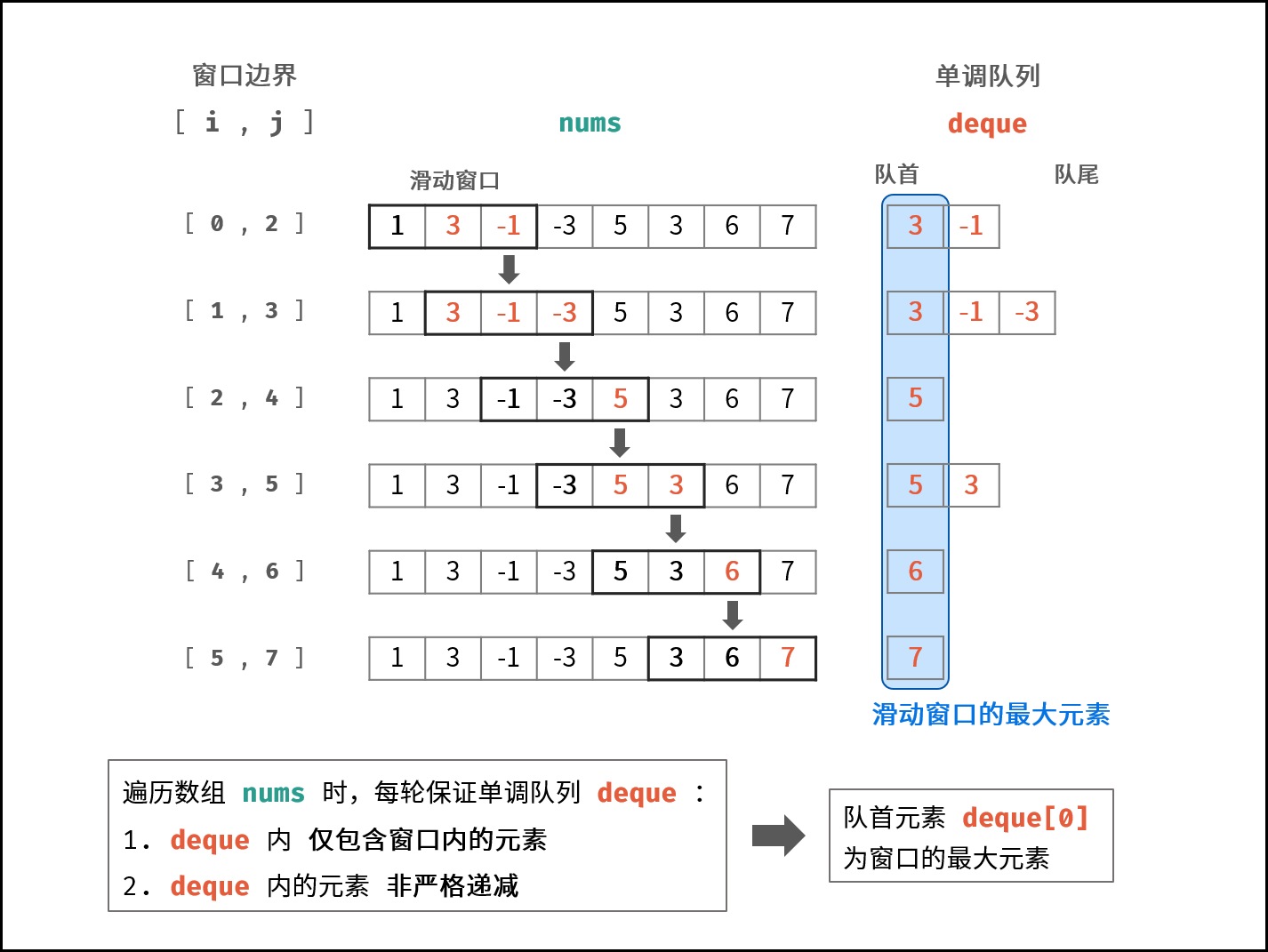
12345678910111213141516171819202122232425262728293031323334 | using std::vector;using std::deque;class Solution { public: vector<int> maxSlidingWindow(vector<int> &nums, int k) { int n = nums.size(); deque<int> q; for (int i = 0; i < k; ++i) { while (!q.empty() && nums[i] >= nums[q.back()]) q.pop_back(); q.push_back(i); } vector<int> ans = { nums[q.front()] }; for (int i = k; i < n; ++i) { while (!q.empty() && nums[i] >= nums[q.back()]) q.pop_back(); q.push_back(i); while (q.front() <= i - k) q.pop_front(); ans.push_back(nums[q.front()]); } return ans; }}; |
acm mode rewrite
123456789101112131415161718192021222324252627282930313233343536 | using std::vector;using std::priority_queue;using std::pair;int main(){ int i, n, k; priority_queue<pair<int, int>, vector<pair<int, int> >, std::less<pair<int, int> > > max_heap; scanf("%d %d", &n, &k); vector<int> vec(n); for (i = 0; i < n; i++) scanf("%d", &vec[i]); for (i = 0; i < k; i++) max_heap.push({ vec[i], i }); printf("%d ", max_heap.top().first); for (; i < n; i++) { while (!max_heap.empty() && i - max_heap.top().second >= k) // Note: check max_heap.empty() to avoid an infinite loop. max_heap.pop(); max_heap.push({ vec[i], i }); printf("%d ", max_heap.top().first); }} |