
时间轴
时间轴
2026-06-29
init
本文介绍了Linux 5.10.x中Rpmsg字符设备驱动的设计与实现。该驱动注册到Rpmsg总线,采用控制设备与端点设备分离的模式:控制节点通过ioctl创建端点,端点设备负责用户态读写消息。文章分析了关键数据结构、锁与等待队列的使用、probe/remove流程、端点的延迟创建机制,以及读写路径中的阻塞唤醒、内存拷贝等细节,并指出了缓冲区大小等注意事项。
当前代码分析基于 linux 5.10.x
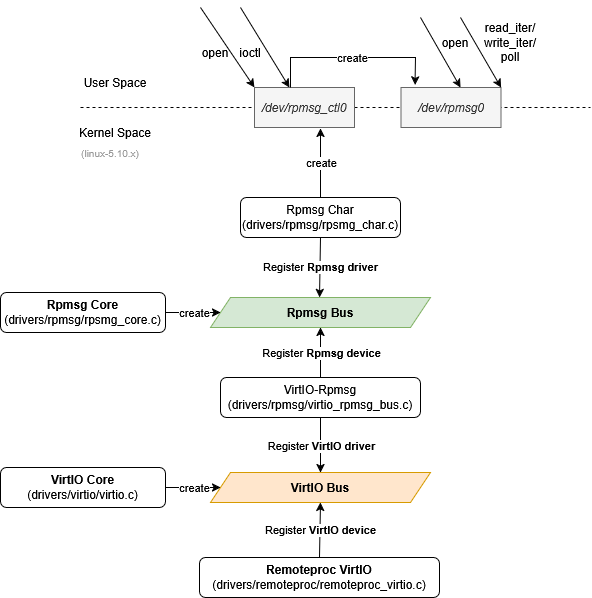
rpmsg_char.c实现了rpmsg_driver并注册到 Rpmsg Bus 总线上,提供与用户态交互的接口,承接virtio_rpmsg_bus.c注册的rpmsg_device
module_init / module_exit
12345678910111213141516171819202122232425262728293031323334353637383940414243 | static dev_t rpmsg_major;static struct class *rpmsg_class;static int rpmsg_char_init(void){ int ret; ret = alloc_chrdev_region(&rpmsg_major, 0, RPMSG_DEV_MAX, "rpmsg"); if (ret < 0) { pr_err("rpmsg: failed to allocate char dev region\n"); return ret; } rpmsg_class = class_create(THIS_MODULE, "rpmsg"); if (IS_ERR(rpmsg_class)) { pr_err("failed to create rpmsg class\n"); unregister_chrdev_region(rpmsg_major, RPMSG_DEV_MAX); return PTR_ERR(rpmsg_class); } ret = register_rpmsg_driver(&rpmsg_chrdev_driver); if (ret < 0) { pr_err("rpmsgchr: failed to register rpmsg driver\n"); class_destroy(rpmsg_class); unregister_chrdev_region(rpmsg_major, RPMSG_DEV_MAX); } return ret;}postcore_initcall(rpmsg_char_init);static void rpmsg_chrdev_exit(void){ unregister_rpmsg_driver(&rpmsg_chrdev_driver); class_destroy(rpmsg_class); unregister_chrdev_region(rpmsg_major, RPMSG_DEV_MAX);}module_exit(rpmsg_chrdev_exit);MODULE_ALIAS("rpmsg:rpmsg_chrdev");MODULE_LICENSE("GPL v2"); |
rpmsg_char.c是一个字符设备驱动,层次结构如下:

注意它用的是postcore_initcall,比module_init早,因为rpmsg_core.c的总线也用postcore_initcall,两者都在驱动模型就绪后注册。
rpmsg_char_init做三件事:
alloc_chrdev_region(&rpmsg_major, 0, RPMSG_DEV_MAX, "rpmsg")—— 动态申请主设备号,RPMSG_DEV_MAX = MINORMASK+1(即全部次设备号空间)。class_create(THIS_MODULE, "rpmsg")—— 创建/sys/class/rpmsg,这样cdev_device_add后会自动在/dev/下生成设备节点(依赖udev/devtmpfs)。register_rpmsg_driver(&rpmsg_chrdev_driver)—— 注册一个 rpmsg 驱动(不是平台驱动!是挂在 rpmsg 总线上的驱动)。
而rpmsg_chrdev_driver如下:
1234567 | static struct rpmsg_driver rpmsg_chrdev_driver = { .probe = rpmsg_chrdev_probe, .remove = rpmsg_chrdev_remove, .drv = { .name = "rpmsg_chrdev", },}; |
关键数据结构
| 类型 | 设备节点 | struct | 谁创建 | 作用 |
|---|---|---|---|---|
| 控制设备 | /dev/rpmsg_ctrl0 | rpmsg_ctrldev | rpmsg_chrdev_probe | 一个 channel 一个;用户通过 ioctl 在它上面"创建端点" |
| 端点设备 | /dev/rpmsg0 | rpmsg_eptdev | rpmsg_ctrldev_ioctl(CREATE) | 一个端点一个;用户 read/write/poll 它来收发消息 |
这种"控制设备 + 数据设备"的分离是 Linux 里很经典的模式:控制节点用来实例化数据节点,数据节点承载真正的 IO。
struct rpmsg_ctrldev
1234567891011 | /** * struct rpmsg_ctrldev - control device for instantiating endpoint devices * @rpdev: underlying rpmsg device * @cdev: cdev for the ctrl device * @dev: device for the ctrl device */struct rpmsg_ctrldev { struct rpmsg_device *rpdev; // 底层 rpmsg 通道设备 struct cdev cdev; // 字符设备 struct device dev; // 嵌入的 device,挂在 rpmsg_class 下}; |
struct rpmsg_eptdev
1234567891011121314151617181920212223242526 | /** * struct rpmsg_eptdev - endpoint device context * @dev: endpoint device * @cdev: cdev for the endpoint device * @rpdev: underlying rpmsg device * @chinfo: info used to open the endpoint * @ept_lock: synchronization of @ept modifications * @ept: rpmsg endpoint reference, when open * @queue_lock: synchronization of @queue operations * @queue: incoming message queue * @readq: wait object for incoming queue */struct rpmsg_eptdev { struct device dev; struct cdev cdev; struct rpmsg_device *rpdev; // 底层通道 struct rpmsg_channel_info chinfo; // open 时用的通道信息(name/src/dst) struct mutex ept_lock; // 保护 ept 指针的修改 struct rpmsg_endpoint *ept; // open 时才创建的真实端点,可为 NULL spinlock_t queue_lock; // 保护接收队列 struct sk_buff_head queue; // 接收消息队列(每条消息一个 skb) wait_queue_head_t readq; // 阻塞读的等待队列}; |
锁和等待队列:
struct mutex ept_lock;:保护 ept 指针。ept 会在三种情况下变 NULL:release、destroy ioctl、父设备remove。读/写路径要先拿这个锁确认 ept 还活着。spinlock_t queue_lock;:保护 queue(skb 链表)。回调rpmsg_ept_cb在中断/原子上下文里入队,read_iter 在进程上下文出队,所以这里用自旋锁且 cb 里用spin_lock,read 里用spin_lock_irqsave。wait_queue_head_t readq;:rpmsg_ept_cb入队后wake_up_interruptible,read_iter在队列空时wait_event_interruptible。这是典型的"生产者-消费者 + 等待队列"。
rpmsg_driver
1234567 | static struct rpmsg_driver rpmsg_chrdev_driver = { .probe = rpmsg_chrdev_probe, .remove = rpmsg_chrdev_remove, .drv = { .name = "rpmsg_chrdev", },}; |
注意:这里没有定义callback函数
rpmsg_chrdev_probe()
12345678910111213141516171819202122232425262728293031323334353637383940414243444546474849505152535455565758596061 | static dev_t rpmsg_major;static struct class *rpmsg_class;static DEFINE_IDA(rpmsg_ctrl_ida);static DEFINE_IDA(rpmsg_ept_ida);static DEFINE_IDA(rpmsg_minor_ida);static int rpmsg_chrdev_probe(struct rpmsg_device *rpdev){ struct rpmsg_ctrldev *ctrldev; struct device *dev; int ret; ctrldev = kzalloc(sizeof(*ctrldev), GFP_KERNEL); if (!ctrldev) return -ENOMEM; ctrldev->rpdev = rpdev; dev = &ctrldev->dev; device_initialize(dev); dev->parent = &rpdev->dev; dev->class = rpmsg_class; cdev_init(&ctrldev->cdev, &rpmsg_ctrldev_fops); ctrldev->cdev.owner = THIS_MODULE; ret = ida_simple_get(&rpmsg_minor_ida, 0, RPMSG_DEV_MAX, GFP_KERNEL); if (ret < 0) goto free_ctrldev; dev->devt = MKDEV(MAJOR(rpmsg_major), ret); ret = ida_simple_get(&rpmsg_ctrl_ida, 0, 0, GFP_KERNEL); if (ret < 0) goto free_minor_ida; dev->id = ret; dev_set_name(&ctrldev->dev, "rpmsg_ctrl%d", ret); ret = cdev_device_add(&ctrldev->cdev, &ctrldev->dev); if (ret) goto free_ctrl_ida; /* We can now rely on the release function for cleanup */ dev->release = rpmsg_ctrldev_release_device; dev_set_drvdata(&rpdev->dev, ctrldev); return ret;free_ctrl_ida: ida_simple_remove(&rpmsg_ctrl_ida, dev->id);free_minor_ida: ida_simple_remove(&rpmsg_minor_ida, MINOR(dev->devt));free_ctrldev: put_device(dev); kfree(ctrldev); return ret;} |
当 rpmsg 总线把一个rpmsg_device匹配给rpmsg_chrdev_driver时调用rpmsg_chrdev_probe。流程:
- kzalloc 一个 ctrldev,
ctrldev->rpdev = rpdev。 device_initialize+ 设parent/class,cdev_init(&ctrldev->cdev, &rpmsg_ctrldev_fops)。- 两次
ida_simple_get:从rpmsg_minor_ida拿次设备号,从rpmsg_ctrl_ida拿 id(用于rpmsg_ctrl%d)。 cdev_device_add—— 把 cdev 和 device 一起注册,/dev/rpmsg_ctrlN出现。- 重点:
dev->release = rpmsg_ctrldev_release_device是在cdev_device_add之后才赋值。注释说"We can now rely on the release function for cleanup"——意思是cdev_device_add成功前若失败,走手动的 error label 释放;成功后则交给 device 模型的 release 回调兜底(最后一个引用归零时 kfree)。这是 Linux 设备模型里很标准的 refcount + release 范式。 dev_set_drvdata(&rpdev->dev, ctrldev)—— 让 remove 时能从 rpdev 找回 ctrldev。
rpmsg_chrdev_remove()
12345678910111213 | static void rpmsg_chrdev_remove(struct rpmsg_device *rpdev){ struct rpmsg_ctrldev *ctrldev = dev_get_drvdata(&rpdev->dev); int ret; /* Destroy all endpoints */ ret = device_for_each_child(&ctrldev->dev, NULL, rpmsg_eptdev_destroy); if (ret) dev_warn(&rpdev->dev, "failed to nuke endpoints: %d\n", ret); cdev_device_del(&ctrldev->cdev, &ctrldev->dev); put_device(&ctrldev->dev);} |
rpmsg_ctrldev 控制节点
file_operations
1234567 | static const struct file_operations rpmsg_ctrldev_fops = { .owner = THIS_MODULE, .open = rpmsg_ctrldev_open, .release = rpmsg_ctrldev_release, .unlocked_ioctl = rpmsg_ctrldev_ioctl, .compat_ioctl = compat_ptr_ioctl,}; |
rpmsg_ctrldev_open()
123456789 | static int rpmsg_ctrldev_open(struct inode *inode, struct file *filp){ struct rpmsg_ctrldev *ctrldev = cdev_to_ctrldev(inode->i_cdev); get_device(&ctrldev->dev); filp->private_data = ctrldev; return 0;} |
rpmsg_ctrldev_release()
12345678 | static int rpmsg_ctrldev_release(struct inode *inode, struct file *filp){ struct rpmsg_ctrldev *ctrldev = cdev_to_ctrldev(inode->i_cdev); put_device(&ctrldev->dev); return 0;} |
probe 函数中有dev->release = rpmsg_ctrldev_release_device;,因此实际release函数为
12345678 | static void rpmsg_ctrldev_release_device(struct device *dev){ struct rpmsg_ctrldev *ctrldev = dev_to_ctrldev(dev); ida_simple_remove(&rpmsg_ctrl_ida, dev->id); ida_simple_remove(&rpmsg_minor_ida, MINOR(dev->devt)); kfree(ctrldev);} |
rpmsg_ctrldev_ioctl()
123456789101112131415161718192021 | static long rpmsg_ctrldev_ioctl(struct file *fp, unsigned int cmd, unsigned long arg){ struct rpmsg_ctrldev *ctrldev = fp->private_data; void __user *argp = (void __user *)arg; struct rpmsg_endpoint_info eptinfo; struct rpmsg_channel_info chinfo; if (cmd != RPMSG_CREATE_EPT_IOCTL) return -EINVAL; if (copy_from_user(&eptinfo, argp, sizeof(eptinfo))) return -EFAULT; memcpy(chinfo.name, eptinfo.name, RPMSG_NAME_SIZE); chinfo.name[RPMSG_NAME_SIZE-1] = '\0'; chinfo.src = eptinfo.src; chinfo.dst = eptinfo.dst; return rpmsg_eptdev_create(ctrldev, chinfo);}; |
通过该函数来创建 ept,调用rpmsg_eptdev_create()
rpmsg_eptdev_create()
123456789101112131415161718192021222324252627282930313233343536373839404142434445464748495051525354555657585960 | static int rpmsg_eptdev_create(struct rpmsg_ctrldev *ctrldev, struct rpmsg_channel_info chinfo){ struct rpmsg_device *rpdev = ctrldev->rpdev; struct rpmsg_eptdev *eptdev; struct device *dev; int ret; eptdev = kzalloc(sizeof(*eptdev), GFP_KERNEL); if (!eptdev) return -ENOMEM; dev = &eptdev->dev; eptdev->rpdev = rpdev; eptdev->chinfo = chinfo; mutex_init(&eptdev->ept_lock); spin_lock_init(&eptdev->queue_lock); skb_queue_head_init(&eptdev->queue); init_waitqueue_head(&eptdev->readq); device_initialize(dev); dev->class = rpmsg_class; dev->parent = &ctrldev->dev; dev->groups = rpmsg_eptdev_groups; dev_set_drvdata(dev, eptdev); cdev_init(&eptdev->cdev, &rpmsg_eptdev_fops); eptdev->cdev.owner = THIS_MODULE; ret = ida_simple_get(&rpmsg_minor_ida, 0, RPMSG_DEV_MAX, GFP_KERNEL); if (ret < 0) goto free_eptdev; dev->devt = MKDEV(MAJOR(rpmsg_major), ret); ret = ida_simple_get(&rpmsg_ept_ida, 0, 0, GFP_KERNEL); if (ret < 0) goto free_minor_ida; dev->id = ret; dev_set_name(dev, "rpmsg%d", ret); ret = cdev_device_add(&eptdev->cdev, &eptdev->dev); if (ret) goto free_ept_ida; /* We can now rely on the release function for cleanup */ dev->release = rpmsg_eptdev_release_device; return ret;free_ept_ida: ida_simple_remove(&rpmsg_ept_ida, dev->id);free_minor_ida: ida_simple_remove(&rpmsg_minor_ida, MINOR(dev->devt));free_eptdev: put_device(dev); kfree(eptdev); return ret;} |
- kzalloc eptdev,填 rpdev、chinfo。
- 初始化锁、skb 队列、等待队列头。
- device_initialize + 设
class/parent/groups/drvdata。groups = rpmsg_eptdev_groups给 sysfs 提供 name/src/dst 只读属性 - cdev_init 用
rpmsg_eptdev_fops。 - 两次 ida_simple_get 拿 minor 和 ept id,
dev_set_name(dev, "rpmsg%d", ret)→/dev/rpmsgN。 - cdev_device_add,成功后设 dev->release。
- 注意:此时
eptdev->ept == NULL!真正的 endpoint 还没创建。端点是在 open 时才建的。这是延迟创建,避免占着地址却没人用。
错误处理路径的 goto 顺序与获取资源的顺序严格相反,是标准的 unwind 风格。注意 free_eptdev 里 put_device 后又 kfree——这里其实有个细节:device_initialize之后该用 put_device 让 release 回调释放,但因为 release 在 cdev_device_add 成功后才设置,此路径下还没设,所以 put_device 不会真的 kfree,需要手动 kfree。这正是 release 延迟赋值带来的代价。
compat_ptr_ioctl()
123456789101112131415161718192021222324252627282930313233 | /** * compat_ptr_ioctl - generic implementation of .compat_ioctl file operation * * This is not normally called as a function, but instead set in struct * file_operations as * * .compat_ioctl = compat_ptr_ioctl, * * On most architectures, the compat_ptr_ioctl() just passes all arguments * to the corresponding ->ioctl handler. The exception is arch/s390, where * compat_ptr() clears the top bit of a 32-bit pointer value, so user space * pointers to the second 2GB alias the first 2GB, as is the case for * native 32-bit s390 user space. * * The compat_ptr_ioctl() function must therefore be used only with ioctl * functions that either ignore the argument or pass a pointer to a * compatible data type. * * If any ioctl command handled by fops->unlocked_ioctl passes a plain * integer instead of a pointer, or any of the passed data types * is incompatible between 32-bit and 64-bit architectures, a proper * handler is required instead of compat_ptr_ioctl. */long compat_ptr_ioctl(struct file *file, unsigned int cmd, unsigned long arg){ if (!file->f_op->unlocked_ioctl) return -ENOIOCTLCMD; return file->f_op->unlocked_ioctl(file, cmd, (unsigned long)compat_ptr(arg));}EXPORT_SYMBOL(compat_ptr_ioctl); |
直接使用fs/ioctl.c中的compat_ptr_ioctl实现,64 位内核兼容 32 位用户态
rpmsg_eptdev ept节点
file_operations
12345678910 | static const struct file_operations rpmsg_eptdev_fops = { .owner = THIS_MODULE, .open = rpmsg_eptdev_open, .release = rpmsg_eptdev_release, .read_iter = rpmsg_eptdev_read_iter, .write_iter = rpmsg_eptdev_write_iter, .poll = rpmsg_eptdev_poll, .unlocked_ioctl = rpmsg_eptdev_ioctl, .compat_ioctl = compat_ptr_ioctl,}; |
rpmsg_eptdev_open()
123456789101112131415161718192021 | static int rpmsg_eptdev_open(struct inode *inode, struct file *filp){ struct rpmsg_eptdev *eptdev = cdev_to_eptdev(inode->i_cdev); struct rpmsg_endpoint *ept; struct rpmsg_device *rpdev = eptdev->rpdev; struct device *dev = &eptdev->dev; get_device(dev); ept = rpmsg_create_ept(rpdev, rpmsg_ept_cb, eptdev, eptdev->chinfo); if (!ept) { dev_err(dev, "failed to open %s\n", eptdev->chinfo.name); put_device(dev); return -EINVAL; } eptdev->ept = ept; filp->private_data = eptdev; return 0;} |
rpmsg_create_ept转发到 core 再到 virtio 后端的virtio_rpmsg_create_ept→__rpmsg_create_ept(virtio_rpmsg_bus.c)。后者在 idr 里分配本地地址(若chinfo.src == RPMSG_ADDR_ANY则从 1024 起动态分配),把回调rpmsg_ept_cb和priv=eptdev绑定到该地址。- 回调注册后,远程发来的、dst 等于这个本地地址的消息,就会触发
rpmsg_ept_cb(见后端rpmsg_recv_single按msg->dst查 idr 并调用ept->cb)。 get_device/ open 失败put_device:保证设备在文件打开期间不会被释放。
而 ept 的 callback 如下:
123456789101112131415161718192021 | static int rpmsg_ept_cb(struct rpmsg_device *rpdev, void *buf, int len, void *priv, u32 addr){ struct rpmsg_eptdev *eptdev = priv; struct sk_buff *skb; skb = alloc_skb(len, GFP_ATOMIC); if (!skb) return -ENOMEM; skb_put_data(skb, buf, len); spin_lock(&eptdev->queue_lock); skb_queue_tail(&eptdev->queue, skb); spin_unlock(&eptdev->queue_lock); /* wake up any blocking processes, waiting for new data */ wake_up_interruptible(&eptdev->readq); return 0;} |
- 后端在 virtqueue 回调(softirq 上下文)里调 ept->cb,所以这里不能用 mutex、不能睡眠,用 GFP_ATOMIC 和自旋锁。
- 这里做了一次内存拷贝(buf → skb)。后端接收时是零拷贝拿到 vring buffer,但为了把数据交给用户态、且不让 buffer 长期被用户持有(后端要尽快把 buffer 还回 rvq),这里拷一份到 skb 里。
rpmsg_recv_single调完 cb 后立刻virtqueue_add_inbuf把原 buffer 还回去。
rpmsg_eptdev_release()
1234567891011121314151617181920 | static int rpmsg_eptdev_release(struct inode *inode, struct file *filp){ struct rpmsg_eptdev *eptdev = cdev_to_eptdev(inode->i_cdev); struct device *dev = &eptdev->dev; /* Close the endpoint, if it's not already destroyed by the parent */ mutex_lock(&eptdev->ept_lock); if (eptdev->ept) { rpmsg_destroy_ept(eptdev->ept); eptdev->ept = NULL; } mutex_unlock(&eptdev->ept_lock); /* Discard all SKBs */ skb_queue_purge(&eptdev->queue); put_device(dev); return 0;} |
当设备需要被彻底移除时(如父设备 remove 或用户态RPMSG_DESTROY_EPT_IOCTL),实际调用的是rpmsg_eptdev_destroy:
12345678910111213141516171819 | static int rpmsg_eptdev_destroy(struct device *dev, void *data){ struct rpmsg_eptdev *eptdev = dev_to_eptdev(dev); mutex_lock(&eptdev->ept_lock); if (eptdev->ept) { rpmsg_destroy_ept(eptdev->ept); eptdev->ept = NULL; } mutex_unlock(&eptdev->ept_lock); /* wake up any blocked readers */ wake_up_interruptible(&eptdev->readq); cdev_device_del(&eptdev->cdev, &eptdev->dev); put_device(&eptdev->dev); return 0;} |
rpmsg_eptdev_read_iter()
12345678910111213141516171819202122232425262728293031323334353637383940414243444546 | static ssize_t rpmsg_eptdev_read_iter(struct kiocb *iocb, struct iov_iter *to){ struct file *filp = iocb->ki_filp; struct rpmsg_eptdev *eptdev = filp->private_data; unsigned long flags; struct sk_buff *skb; int use; if (!eptdev->ept) return -EPIPE; spin_lock_irqsave(&eptdev->queue_lock, flags); /* Wait for data in the queue */ if (skb_queue_empty(&eptdev->queue)) { spin_unlock_irqrestore(&eptdev->queue_lock, flags); if (filp->f_flags & O_NONBLOCK) return -EAGAIN; /* Wait until we get data or the endpoint goes away */ if (wait_event_interruptible(eptdev->readq, !skb_queue_empty(&eptdev->queue) || !eptdev->ept)) return -ERESTARTSYS; /* We lost the endpoint while waiting */ if (!eptdev->ept) return -EPIPE; spin_lock_irqsave(&eptdev->queue_lock, flags); } skb = skb_dequeue(&eptdev->queue); spin_unlock_irqrestore(&eptdev->queue_lock, flags); if (!skb) return -EFAULT; use = min_t(size_t, iov_iter_count(to), skb->len); if (copy_to_iter(skb->data, use, to) != use) use = -EFAULT; kfree_skb(skb); return use;} |
- 等待条件里同时检查
!ept:这样当 destroy 把 ept 置 NULL 并 wake_up 时,阻塞的读能立刻醒来返回 -EPIPE,不会永远卡死。这是把"资源消失"作为唤醒条件的标准写法。 - 一次 read 取一条消息:rpmsg 是消息边界明确的协议,一条 skb = 一条 rpmsg 消息。
use = min_t(size_t, iov_iter_count(to), skb->len);意味着如果用户 buffer 比消息小,多余部分被丢弃(skb 直接 free)。这对初学者是个坑:buffer 要足够大(后端 buffer 是 512 字节减 16 字节头 = 496 字节 payload)。 - 用
spin_lock_irqsave而非spin_lock:因为读可能在普通进程上下文,但锁可能被中断上下文的 cb 持有,关中断更安全。
rpmsg_eptdev_write_iter()
12345678910111213141516171819202122232425262728293031323334353637383940 | static ssize_t rpmsg_eptdev_write_iter(struct kiocb *iocb, struct iov_iter *from){ struct file *filp = iocb->ki_filp; struct rpmsg_eptdev *eptdev = filp->private_data; size_t len = iov_iter_count(from); void *kbuf; int ret; kbuf = kzalloc(len, GFP_KERNEL); if (!kbuf) return -ENOMEM; if (!copy_from_iter_full(kbuf, len, from)) { ret = -EFAULT; goto free_kbuf; } if (mutex_lock_interruptible(&eptdev->ept_lock)) { ret = -ERESTARTSYS; goto free_kbuf; } if (!eptdev->ept) { ret = -EPIPE; goto unlock_eptdev; } if (filp->f_flags & O_NONBLOCK) ret = rpmsg_trysend(eptdev->ept, kbuf, len); else ret = rpmsg_send(eptdev->ept, kbuf, len);unlock_eptdev: mutex_unlock(&eptdev->ept_lock);free_kbuf: kfree(kbuf); return ret < 0 ? ret : len;} |
先
copy_from_iter再拿锁,因为用户态拷贝可能缺页睡眠,不应在持有 ept_lock 时进行——否则会长时间阻塞 destroy 路径。rpmsg_send阻塞版会一路走到后端rpmsg_send_offchannel_raw(..., wait=true):没 TX buffer 就wait_event_interruptible_timeout(..., 15000)。rpmsg_trysend是wait=false,没 buffer 立即-ENOMEM。成功返回 len(写入字节数),不是 ret(后端 ret 是 0)。注意单条消息受后端 buffer 限制:
len > buf_size - sizeof(hdr)即 496 字节会-EMSGSIZE。发送同样是一次 write = 一条消息,没有流式拼接。
rpmsg_eptdev_poll()
1234567891011121314151617 | static __poll_t rpmsg_eptdev_poll(struct file *filp, poll_table *wait){ struct rpmsg_eptdev *eptdev = filp->private_data; __poll_t mask = 0; if (!eptdev->ept) return EPOLLERR; poll_wait(filp, &eptdev->readq, wait); if (!skb_queue_empty(&eptdev->queue)) mask |= EPOLLIN | EPOLLRDNORM; mask |= rpmsg_poll(eptdev->ept, filp, wait); return mask;} |
rpmsg_eptdev_ioctl()
12345678910 | static long rpmsg_eptdev_ioctl(struct file *fp, unsigned int cmd, unsigned long arg){ struct rpmsg_eptdev *eptdev = fp->private_data; if (cmd != RPMSG_DESTROY_EPT_IOCTL) return -EINVAL; return rpmsg_eptdev_destroy(&eptdev->dev, NULL);} |
rpmsg_poll 转发到后端的ops->poll——但注意 virtio 后端的virtio_endpoint_ops没有实现 poll,所以rpmsg_poll里if (!ept->ops->poll) return 0,即该后端下 poll 只报可读,不报可写。这是后端可选实现。