
时间轴
时间轴
2026-06-22
init
本文介绍了Linux内核中基于virtio的rpmsg总线驱动(virtio_rpmsg_bus),阐述了其作为rpmsg总线的virtio传输实现,负责在Linux主核与远端处理器之间通过vring收发消息,并将远端服务抽象为rpmsg_device供上层驱动绑定。文章详细分析了rpmsg的三层结构、通信模型,以及核心数据结构如rpmsg_device、rpmsg_endpoint和virtproc_info,并说明了endpoint的创建与销毁、缓冲区管理、发送同步和名字服务等关键机制。最后指出rpmsg实际是基于地址的消息分发机制。
linux 5.10.238
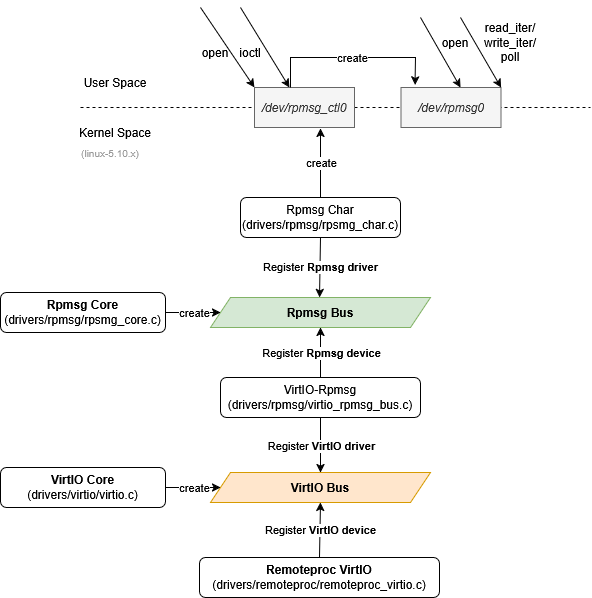
rpmsg 结构
rpmsg 有三层:
123456789101112 | ┌────────────────────────────────────────┐│ 业务层:rpmsg_driver │ ← 写业务的地方│ (rpmsg_tty / rpmsg_chrdev / 自定义) │├────────────────────────────────────────┤│ rpmsg 总线 / core:rpmsg_core.c │ ← 匹配 device 和 driver│ rpmsg_device / rpmsg_endpoint │├────────────────────────────────────────┤│ transport 后端:virtio_rpmsg_bus.c │ ← 本博客重点分析的代码│ (virtio_driver,搬运消息、造 channel) │├────────────────────────────────────────┤│ virtio 总线 / vring │└────────────────────────────────────────┘ |
virtio_rpmsg_bus.c在中下层,它的职责是:
- 接管 virtio rpmsg 设备
- 用 vring 收发消息
- 根据 name service 创建/销毁 rpmsg_device
它生产rpmsg_device,但不消费。消费者是rpmsg_driver。
module_init/module_exit
12345678910111213141516171819202122232425262728293031323334353637383940 | static struct virtio_device_id id_table[] = { { VIRTIO_ID_RPMSG, VIRTIO_DEV_ANY_ID }, { 0 },};static unsigned int features[] = { VIRTIO_RPMSG_F_NS,};static struct virtio_driver virtio_ipc_driver = { .feature_table = features, .feature_table_size = ARRAY_SIZE(features), .driver.name = KBUILD_MODNAME, .driver.owner = THIS_MODULE, .id_table = id_table, .probe = rpmsg_probe, .remove = rpmsg_remove,};static int __init rpmsg_init(void){ int ret; ret = register_virtio_driver(&virtio_ipc_driver); if (ret) pr_err("failed to register virtio driver: %d\n", ret); return ret;}subsys_initcall(rpmsg_init);static void __exit rpmsg_fini(void){ unregister_virtio_driver(&virtio_ipc_driver);}module_exit(rpmsg_fini);MODULE_DEVICE_TABLE(virtio, id_table);MODULE_DESCRIPTION("Virtio-based remote processor messaging bus");MODULE_LICENSE("GPL v2"); |
virtio_rpmsg_bus.c是 Linux 内核里 基于 virtio 的 rpmsg 总线驱动。它的作用是:
让 Linux 主核和远端处理器之间,通过 virtio vring 机制收发 rpmsg 消息,并把远端服务抽象成 Linux 的
rpmsg_device,供上层 rpmsg driver 绑定使用。
这个文件本身是 rpmsg bus 的 virtio transport 实现,它不关心具体业务协议,比如音频、传感器、TEE、MCU 控制等;它只负责把消息送到对应 endpoint。
基本通信模型
rpmsg
rpmsg 的通信单元是:
rpmsg_devicerpmsg channel device, 一条通信通道(channel),是“设备”rpmsg_driver处理这条通道业务的驱动rpmsg_endpoint通道上的实际收发端点(地址 + callback)
三者之间关系:
12345 | rpmsg_driver ←—— 匹配 ——→ rpmsg_device | | 持有 v rpmsg_endpoint |
rpmsg_device 就是中间那个“被驱动管理的设备”。当创建rpmsg_device时会触发 probe 函数进行匹配,匹配成功后调用rpmsg_driver->probe函数
struct rpmsg_device
12345678910111213141516 | struct rpmsg_device ├── u32 src ├── u32 dst ├── bool announce ├── struct device dev ├── struct rpmsg_device_id id; ├── const char *driver_override; ├── const struct rpmsg_device_ops *ops; └── struct rpmsg_endpoint *ept ├── u32 addr ├── void *priv ├── rpmsg_rx_cb_t cb ├── struct mutex cb_lock ├── struct kref refcount ├── struct rpmsg_device *rpdev └── const struct rpmsg_endpoint_ops *ops |
其中struct rpmsg_device定义如下:
1234567891011121314151617181920212223 | /** * rpmsg_device - device that belong to the rpmsg bus * @dev: the device struct * @id: device id (used to match between rpmsg drivers and devices) * @driver_override: driver name to force a match; do not set directly, * because core frees it; use driver_set_override() to * set or clear it. * @src: local address * @dst: destination address * @ept: the rpmsg endpoint of this channel * @announce: if set, rpmsg will announce the creation/removal of this channel */struct rpmsg_device { struct device dev; struct rpmsg_device_id id; const char *driver_override; u32 src; u32 dst; struct rpmsg_endpoint *ept; bool announce; const struct rpmsg_device_ops *ops;}; |
struct rpmsg_device_ops表示一个rpmsg_device的 operation
123456789101112131415161718 | /*** struct rpmsg_device_ops - indirection table for the rpmsg_device operations* @create_ept: create backend-specific endpoint, required* @announce_create: announce presence of new channel, optional* @announce_destroy: announce destruction of channel, optional** Indirection table for the operations that a rpmsg backend should implement.* @announce_create and @announce_destroy are optional as the backend might* advertise new channels implicitly by creating the endpoints.*/struct rpmsg_device_ops { struct rpmsg_endpoint *(*create_ept)(struct rpmsg_device *rpdev, rpmsg_rx_cb_t cb, void *priv, struct rpmsg_channel_info chinfo); int (*announce_create)(struct rpmsg_device *ept); int (*announce_destroy)(struct rpmsg_device *ept);}; |
一个 rpmsg_device 等价于一条逻辑通道,比如:
channel name: “rpmsg-demo”src: 本地 endpoint 地址dst: 远端 endpoint 地址
在virtio_rpmsg_bus.c里,channel 是这样创建的(rpmsg_create_channel()):
1234 | rpdev->src = chinfo->src;rpdev->dst = chinfo->dst;rpdev->ops = &virtio_rpmsg_ops;strncpy(rpdev->id.name, chinfo->name, RPMSG_NAME_SIZE); |
也就是说:远端 announce 一个服务 “rpmsg-demo”,Linux 创建一个rpmsg_device代表这条 channel;或者本地主动创建一个服务 “rpmsg-demo”,即创建一个rpmsg_device代表本地 channel。announce 之后,由 NS 服务通知远端也创建 “rpmsg-demo” 的 channel。本地和远端的rpmsg_device的 src 和 dst 彼此相反,通过这条通道进行通信。
实际上virtio_rpmsg_bus.c中抽象的rpmsg channel descriptor为
12345678910111213 | /** * struct virtio_rpmsg_channel - rpmsg channel descriptor * @rpdev: the rpmsg channel device * @vrp: the virtio remote processor device this channel belongs to * * This structure stores the channel that links the rpmsg device to the virtio * remote processor device. */struct virtio_rpmsg_channel { struct rpmsg_device rpdev; struct virtproc_info *vrp;}; |
即一个rpmsg_device还要加上核心数据结构struct virtproc_info *vrp,这是 virtio 实现 rpmsg bus 的关键数据结构
struct rpmsg_endpoint
rpmsg_device就像一根电话线 + 一个分机号服务,而rpmsg_endpoint代表实际接听电话的人
123456789101112131415161718192021222324252627282930313233 | /** * struct rpmsg_endpoint - binds a local rpmsg address to its user * @rpdev: rpmsg channel device * @refcount: when this drops to zero, the ept is deallocated * @cb: rx callback handler * @cb_lock: must be taken before accessing/changing @cb * @addr: local rpmsg address * @priv: private data for the driver's use * * In essence, an rpmsg endpoint represents a listener on the rpmsg bus, as * it binds an rpmsg address with an rx callback handler. * * Simple rpmsg drivers shouldn't use this struct directly, because * things just work: every rpmsg driver provides an rx callback upon * registering to the bus, and that callback is then bound to its rpmsg * address when the driver is probed. When relevant inbound messages arrive * (i.e. messages which their dst address equals to the src address of * the rpmsg channel), the driver's handler is invoked to process it. * * More complicated drivers though, that do need to allocate additional rpmsg * addresses, and bind them to different rx callbacks, must explicitly * create additional endpoints by themselves (see rpmsg_create_ept()). */struct rpmsg_endpoint { struct rpmsg_device *rpdev; struct kref refcount; rpmsg_rx_cb_t cb; struct mutex cb_lock; u32 addr; void *priv; const struct rpmsg_endpoint_ops *ops;}; |
rpmsg_endpoint相关逻辑主要在rpmsg_core.c中,其中最重要的是rpmsg_rx_cb_t cb和const struct rpmsg_endpoint_ops *ops这两个成员:
1 | typedef int (*rpmsg_rx_cb_t)(struct rpmsg_device *, void *, int, void *, u32); |
该函数表示该ept收到消息后触发的回调函数
123456789101112131415161718192021222324252627282930 | /** * struct rpmsg_endpoint_ops - indirection table for rpmsg_endpoint operations * @destroy_ept: see @rpmsg_destroy_ept(), required * @send: see @rpmsg_send(), required * @sendto: see @rpmsg_sendto(), optional * @send_offchannel: see @rpmsg_send_offchannel(), optional * @trysend: see @rpmsg_trysend(), required * @trysendto: see @rpmsg_trysendto(), optional * @trysend_offchannel: see @rpmsg_trysend_offchannel(), optional * @poll: see @rpmsg_poll(), optional * * Indirection table for the operations that a rpmsg backend should implement. * In addition to @destroy_ept, the backend must at least implement @send and * @trysend, while the variants sending data off-channel are optional. */struct rpmsg_endpoint_ops { void (*destroy_ept)(struct rpmsg_endpoint *ept); int (*send)(struct rpmsg_endpoint *ept, void *data, int len); int (*sendto)(struct rpmsg_endpoint *ept, void *data, int len, u32 dst); int (*send_offchannel)(struct rpmsg_endpoint *ept, u32 src, u32 dst, void *data, int len); int (*trysend)(struct rpmsg_endpoint *ept, void *data, int len); int (*trysendto)(struct rpmsg_endpoint *ept, void *data, int len, u32 dst); int (*trysend_offchannel)(struct rpmsg_endpoint *ept, u32 src, u32 dst, void *data, int len); __poll_t (*poll)(struct rpmsg_endpoint *ept, struct file *filp, poll_table *wait);}; |
表示 rpmsg_endpoint 的 operation 函数。
endpoint 创建
核心函数是:__rpmsg_create_ept(),它是rpmsg_device的operation函数
123456789101112131415161718192021222324252627282930313233343536373839404142434445464748495051525354555657585960 | /* for more info, see below documentation of rpmsg_create_ept() */static struct rpmsg_endpoint *__rpmsg_create_ept(struct virtproc_info *vrp, struct rpmsg_device *rpdev, rpmsg_rx_cb_t cb, void *priv, u32 addr){ int id_min, id_max, id; struct rpmsg_endpoint *ept; struct device *dev = rpdev ? &rpdev->dev : &vrp->vdev->dev; ept = kzalloc(sizeof(*ept), GFP_KERNEL); if (!ept) return NULL; kref_init(&ept->refcount); mutex_init(&ept->cb_lock); ept->rpdev = rpdev; ept->cb = cb; ept->priv = priv; ept->ops = &virtio_endpoint_ops; /* do we need to allocate a local address ? */ if (addr == RPMSG_ADDR_ANY) { id_min = RPMSG_RESERVED_ADDRESSES; id_max = 0; } else { id_min = addr; id_max = addr + 1; } mutex_lock(&vrp->endpoints_lock); /* bind the endpoint to an rpmsg address (and allocate one if needed) */ id = idr_alloc(&vrp->endpoints, ept, id_min, id_max, GFP_KERNEL); if (id < 0) { dev_err(dev, "idr_alloc failed: %d\n", id); goto free_ept; } ept->addr = id; mutex_unlock(&vrp->endpoints_lock); return ept;free_ept: mutex_unlock(&vrp->endpoints_lock); kref_put(&ept->refcount, __ept_release); return NULL;}static struct rpmsg_endpoint *virtio_rpmsg_create_ept(struct rpmsg_device *rpdev, rpmsg_rx_cb_t cb, void *priv, struct rpmsg_channel_info chinfo){ struct virtio_rpmsg_channel *vch = to_virtio_rpmsg_channel(rpdev); return __rpmsg_create_ept(vch->vrp, rpdev, cb, priv, chinfo.src);} |
- 分配
struct rpmsg_endpoint - 初始化引用计数和 callback lock
- 记录 callback、private data、ops
- 给 endpoint 分配本地地址
- 插入
vrp->endpoints这个 idr
关键逻辑:
1234567 | if (addr == RPMSG_ADDR_ANY) { id_min = RPMSG_RESERVED_ADDRESSES; id_max = 0;} else { id_min = addr; id_max = addr + 1;} |
- 如果调用方不指定地址,则动态分配
- 动态地址从
1024开始 0 ~ 1023保留给预定义服务
而保留地址定义:
1 | |
endpoint 地址通过idr_alloc()分配:
1 | id = idr_alloc(&vrp->endpoints, ept, id_min, id_max, GFP_KERNEL); |
endpoint 销毁
核心函数:__rpmsg_destroy_ept(),它是rpmsg_endpoint的operation函数
- 从
idr中删除 endpoint - 把 callback 设置成
NULL - 减引用计数,必要时释放 endpoint
关键代码:
12345678910111213141516171819202122232425 | /** * __rpmsg_destroy_ept() - destroy an existing rpmsg endpoint * @vrp: virtproc which owns this ept * @ept: endpoing to destroy * * An internal function which destroy an ept without assuming it is * bound to an rpmsg channel. This is needed for handling the internal * name service endpoint, which isn't bound to an rpmsg channel. * See also __rpmsg_create_ept(). */static void__rpmsg_destroy_ept(struct virtproc_info *vrp, struct rpmsg_endpoint *ept){ /* make sure new inbound messages can't find this ept anymore */ mutex_lock(&vrp->endpoints_lock); idr_remove(&vrp->endpoints, ept->addr); mutex_unlock(&vrp->endpoints_lock); /* make sure in-flight inbound messages won't invoke cb anymore */ mutex_lock(&ept->cb_lock); ept->cb = NULL; mutex_unlock(&ept->cb_lock); kref_put(&ept->refcount, __ept_release);} |
这里特别注意并发:
- 删除 idr:防止新的 RX 消息找到这个 endpoint
- 设置
cb = NULL:防止已经拿到 endpoint 的 in-flight RX 调用 callback kref:防止 RX 路径正在使用 endpoint 时被释放
struct virtproc_info
核心数据结构:struct virtproc_info
123456789101112131415 | struct virtproc_info { struct virtio_device *vdev; struct virtqueue *rvq, *svq; void *rbufs, *sbufs; unsigned int num_bufs; unsigned int buf_size; int last_sbuf; dma_addr_t bufs_dma; struct mutex tx_lock; struct idr endpoints; struct mutex endpoints_lock; wait_queue_head_t sendq; atomic_t sleepers; struct rpmsg_endpoint *ns_ept;}; |
这是整个 virtio rpmsg 设备的私有状态,挂在vdev->priv = vrp中, 按功能划分
- virtio 基础:
vdev底层 virtio 设备
- 收发通道:
rvq,svqRX/TX virtqueue
- buffer 管理:
rbufs,sbufsRX/TX buffer 虚拟地址num_bufs总 buffer 数buf_size单 buffer 大小last_sbufTX 开荒游标bufs_dmabuffer DMA 基址
- 发送同步:
tx_lock保护 svq/sbufs/sleeperssendq等待 TX buffer 的等待队列sleepers等待者计数(控制 tx-complete 中断开关)
- endpoint 管理:
endpointsendpoint idr(按地址查找)endpoints_lock保护 endpoint 表
- name service:
ns_ept名字服务 endpoint(addr 53)
struct virtio_device *vdev
作用:指向底层的 virtio 设备。它是这个 rpmsg 实例的根。通过它可以拿到:
- vdev->dev 设备节点(dev_err/dev_dbg 用)
- vdev->config virtio 配置操作(reset/del_vqs 等)
- vdev->priv 反向指回 vrp 自己
probe 里设置:
123 | vrp->vdev = vdev;...vdev->priv = vrp; |
callback 里就靠它取回 vrp:
1 | struct virtproc_info *vrp = rvq->vdev->priv; |
struct virtqueue *rvq, *svq
作用:
- rvq = receive virtqueue:远端 -> Linux
- svq = send virtqueue: Linux -> 远端
这是收发的两条通道。probe 里:
12 | vrp->rvq = vqs[0]; /* input */vrp->svq = vqs[1]; /* output */ |
- 接收消息:
virtqueue_get_buf(rvq)/virtqueue_add_inbuf(rvq) - 发送消息:
virtqueue_add_outbuf(svq)/virtqueue_get_buf(svq)
void *rbufs, *sbufs
作用:
rbufs:RX buffer 区域的内核虚拟地址起点
sbufs:TX buffer 区域的内核虚拟地址起点
probe 里把一整块 DMA 内存切两半:
12 | vrp->rbufs = bufs_va; /* 前半 RX */vrp->sbufs = bufs_va + total_buf_space / 2; /* 后半 TX */ |
如图
123 | bufs_va ├── rbufs:RX[0] RX[1] ... └── sbufs:TX[0] TX[1] ... |
get_a_tx_buf()就是从 sbufs 上按索引取 TX buffer:
1 | ret = vrp->sbufs + vrp->buf_size * vrp->last_sbuf++; |
unsigned int num_bufs
作用:RX + TX 的 buffer 总数(两者各占一半)。probe 里根据 vring 大小计算:
1234 | if (virtqueue_get_vring_size(vrp->rvq) < MAX_RPMSG_NUM_BUFS / 2) vrp->num_bufs = virtqueue_get_vring_size(vrp->rvq) * 2;else vrp->num_bufs = MAX_RPMSG_NUM_BUFS; /* 512 */ |
所以:
12 | RX buffer 数 = num_bufs / 2TX buffer 数 = num_bufs / 2 |
多处都用num_bufs / 2作为边界,例如get_a_tx_buf():
1 | if (vrp->last_sbuf < vrp->num_bufs / 2) |
unsigned int buf_size
作用:单个 buffer 的字节数,当前固定 512(MAX_RPMSG_BUF_SIZE)。
probe函数中
1 | vrp->buf_size = MAX_RPMSG_BUF_SIZE; |
它决定:
- 每个 buffer 的地址步长:
sbufs + buf_size * i - 单条消息 payload 上限
12 | if (len > vrp->buf_size - sizeof(struct rpmsg_hdr)) return -EMSGSIZE; |
int last_sbuf
作用:TX buffer 的“开荒游标”,记录初次顺序分配到第几个。在get_a_tx_buf()里用:
1234 | if (vrp->last_sbuf < vrp->num_bufs / 2) ret = vrp->sbufs + vrp->buf_size * vrp->last_sbuf++;else ret = virtqueue_get_buf(vrp->svq, &len); |
last_sbuf < num_bufs/2:还有没用过的新 TX buffer,按序拿- 否则:所有 TX buffer 都用过,改从 used ring 回收复用
一旦达到上限,last_sbuf就固定不再增长,后续全靠virtqueue_get_buf()回收。
dma_addr_t bufs_dma
作用:整块 buffer 的 DMA 基地址(设备/DMA 视角的地址)。probe 里由dma_alloc_coherent()返回:
12 | bufs_va = dma_alloc_coherent(vdev->dev.parent, total_buf_space, &vrp->bufs_dma, GFP_KERNEL); |
rbufs/sbufs是 CPU 用的虚拟地址,bufs_dma 是释放和 DMA 映射时用的物理/总线地址。remove 时用它释放:
12 | dma_free_coherent(vdev->dev.parent, total_buf_space, vrp->rbufs, vrp->bufs_dma); |
struct mutex tx_lock
作用:保护发送侧的共享状态:svq、sbufs、sleepers。允许多个发送者并发调用rpmsg_send()。用 mutex 是因为发送可能要唤醒在“打盹”的远端处理器,这个过程可能睡眠,所以必须用可睡眠的 mutex。
struct idr endpoints
作用:本地所有 endpoint 的 idr 索引表,key 是 endpoint 地址。用于快速按地址查找 endpoint。这是消息分发的核心数据结构。创建 endpoint 时分配地址并插入:
12 | id = idr_alloc(&vrp->endpoints, ept, id_min, id_max, GFP_KERNEL);ept->addr = id; |
接收消息时按 dst 查找:
1 | ept = idr_find(&vrp->endpoints, virtio32_to_cpu(vrp->vdev, msg->dst)); |
所以 rpmsg 实际是address-based dispatch,靠的就是这个 idr。
struct mutex endpoints_lock
作用:保护 endpoints idr 的并发访问。增删查改 endpoint 时都要持有:
12345 | mutex_lock(&vrp->endpoints_lock);ept = idr_find(&vrp->endpoints, ...);if (ept) kref_get(&ept->refcount); /* 查到后先加引用,防止释放 */mutex_unlock(&vrp->endpoints_lock); |
注意它和 tx_lock 是两把不同的锁:
-tx_lock保护发送路径
-endpoints_lock保护 endpoint 表
wait_queue_head_t sendq
作用:等待 TX buffer 的发送者睡在这个等待队列上。没有 TX buffer 时,rpmsg_send() 睡眠等待:
123 | wait_event_interruptible_timeout(vrp->sendq, (msg = get_a_tx_buf(vrp)), msecs_to_jiffies(15000)); |
远端消费完 TX buffer 后,TX complete callback 唤醒它:
12345 | static void rpmsg_xmit_done(struct virtqueue *svq){ struct virtproc_info *vrp = svq->vdev->priv; wake_up_interruptible(&vrp->sendq);} |
atomic_t sleepers
作用:当前有多少个发送者正在等待 TX buffer(等待者计数)。它配合 TX complete 中断的动态开关:
1234567 | /* 第一个等待者:打开 tx-complete callback */if (atomic_inc_return(&vrp->sleepers) == 1) virtqueue_enable_cb(vrp->svq);/* 最后一个等待者:关闭 tx-complete callback */if (atomic_dec_and_test(&vrp->sleepers)) virtqueue_disable_cb(vrp->svq); |
设计目的:
- 没人等 TX buffer:关闭 tx-complete 中断,省开销
- 有人等 TX buffer:打开 tx-complete 中断,远端归还 buffer 后立即唤醒
(这是 5.10 的设计,Linux 7.1.1 版本的因为引入 poll 支持已去掉 sleepers。)
struct rpmsg_endpoint *ns_ept
作用:name service 专用 endpoint(固定地址 53)。它不属于任何普通 rpmsg channel,是 bus 内部用来处理远端服务“创建/销毁”通知的。probe 里在远端支持 NS feature 时创建:
1234 | if (virtio_has_feature(vdev, VIRTIO_RPMSG_F_NS)) { vrp->ns_ept = __rpmsg_create_ept(vrp, NULL, rpmsg_ns_cb, vrp, RPMSG_NS_ADDR);} |
它的 callback 是rpmsg_ns_cb(),负责按 NS 消息创建/销毁 rpmsg_device。remove 时单独销毁:
12 | if (vrp->ns_ept) __rpmsg_destroy_ept(vrp, vrp->ns_ept); |
注意创建时 rpdev 传 NULL,因为它不绑定具体 channel。
buffer 设计
驱动使用固定大小 buffer。相关定义:
12 |
- 最多 512 个 buffer
- 一半 RX,一半 TX
- 每个 buffer 512 字节
- 最大总内存 512 * 512 = 256 KiB
也就是说:
12345678910 | 总 buffer 区域+------------------------+ <-- vrp->rbufs = bufs_va = dma_alloc_coherent(vdev->dev.parent,| | total_buf_space, &vrp->bufs_dma,GFP_KERNEL);| RX Buffer (前一半) || |+------------------------+ <-- vrp->sbufs = bufs_va + total_buf_space / 2;| || TX Buffer (后一半) || |+------------------------+ <-- vrp->rbufs + total_buf_space |
在 probe 里分配:
123 | bufs_va = dma_alloc_coherent(vdev->dev.parent, total_buf_space, &vrp->bufs_dma, GFP_KERNEL); |
然后切分:
12 | vrp->rbufs = bufs_va;vrp->sbufs = bufs_va + total_buf_space / 2; |
发送的每条消息都有一个公共头:
12345678 | struct rpmsg_hdr { __virtio32 src; __virtio32 dst; __virtio32 reserved; __virtio16 len; __virtio16 flags; u8 data[];} __packed; |
含义:
| 字段 | 含义 |
|---|---|
src | 源 endpoint 地址 |
dst | 目标 endpoint 地址 |
reserved | 保留 |
len | payload 长度 |
flags | 消息标志 |
data[] | 实际业务数据 |
Linux 收到消息后,会根据dst地址找到本地 endpoint,然后调用该 endpoint 的 callback。
get_a_tx_buf()
代码:
1234567891011121314151617181920212223 | /* super simple buffer "allocator" that is just enough for now */static void *get_a_tx_buf(struct virtproc_info *vrp){ unsigned int len; void *ret; /* support multiple concurrent senders */ mutex_lock(&vrp->tx_lock); /* * either pick the next unused tx buffer * (half of our buffers are used for sending messages) */ if (vrp->last_sbuf < vrp->num_bufs / 2) ret = vrp->sbufs + vrp->buf_size * vrp->last_sbuf++; /* or recycle a used one */ else ret = virtqueue_get_buf(vrp->svq, &len); mutex_unlock(&vrp->tx_lock); return ret;} |
这个函数是一个很简单的 TX buffer allocator。
它有两个阶段:
12345 | 阶段 1:还有从未使用过的 TX buffer 按数组顺序从 vrp->sbufs 里拿阶段 2:所有 TX buffer 都至少用过一次 从 svq used ring 回收远端已经读完的 TX buffer |
last_sbuf只在第一阶段有用。
一旦:
1 | vrp->last_sbuf == vrp->num_bufs / 2 |
后续就一直走:
1 | virtqueue_get_buf(vrp->svq, &len); |
也就是说:
12 | last_sbuf = 一次性“开荒游标”virtqueue_get_buf() = 后续复用 buffer 的来源 |
virtio API
| API | 作用 |
|---|---|
virtio_find_vqs() | 找/创建 virtqueue |
virtqueue_add_inbuf() | 给设备一个“可写入”的 buffer |
virtqueue_add_outbuf() | 给设备一个“可读取”的 buffer |
virtqueue_add_sgs | 通用的缓冲区添加函数,包含 in 和 out |
virtqueue_get_buf() | 从 used ring 取回设备处理完的 buffer |
virtqueue_kick() | 通知对方:队列有新缓冲区 |
virtqueue_kick_prepare() | 判断是否需要通知 |
virtqueue_notify() | 真正发通知 |
virtqueue_enable_cb() | 打开 virtqueue callback/中断 |
virtqueue_disable_cb() | 关闭 virtqueue callback/中断,用于轮询期间防止中断风暴 |
virtqueue_get_vring_size() | 获取 ring 大小 |
virtio_has_feature() | 检查 virtio feature |
virtio_device_ready() | 设置 DRIVER_OK,设备可以开始工作 |
probe 函数
123456789 | static struct virtio_driver virtio_ipc_driver = { .feature_table = features, .feature_table_size = ARRAY_SIZE(features), .driver.name = KBUILD_MODNAME, .driver.owner = THIS_MODULE, .id_table = id_table, .probe = rpmsg_probe, .remove = rpmsg_remove,}; |
virtio_driver.probe函数定义为:
123456789101112131415161718192021222324252627282930313233343536373839404142434445464748495051525354555657585960616263646566676869707172737475767778798081828384858687888990919293949596979899100101102103104105106107108109110111112113114115116117118119120121122123 | static int rpmsg_probe(struct virtio_device *vdev){ vq_callback_t *vq_cbs[] = { rpmsg_recv_done, rpmsg_xmit_done }; static const char * const names[] = { "input", "output" }; struct virtqueue *vqs[2]; struct virtproc_info *vrp; void *bufs_va; int err = 0, i; size_t total_buf_space; bool notify; // 分配struct virtproc_info vrp = kzalloc(sizeof(*vrp), GFP_KERNEL); if (!vrp) return -ENOMEM; vrp->vdev = vdev; // 初始化struct virtproc_info的成员 idr_init(&vrp->endpoints); mutex_init(&vrp->endpoints_lock); mutex_init(&vrp->tx_lock); init_waitqueue_head(&vrp->sendq); /* We expect two virtqueues, rx and tx (and in this order) */ err = virtio_find_vqs(vdev, 2, vqs, vq_cbs, names, NULL); if (err) goto free_vrp; vrp->rvq = vqs[0]; vrp->svq = vqs[1]; /* we expect symmetric tx/rx vrings */ WARN_ON(virtqueue_get_vring_size(vrp->rvq) != virtqueue_get_vring_size(vrp->svq)); /* we need less buffers if vrings are small */ if (virtqueue_get_vring_size(vrp->rvq) < MAX_RPMSG_NUM_BUFS / 2) vrp->num_bufs = virtqueue_get_vring_size(vrp->rvq) * 2; else vrp->num_bufs = MAX_RPMSG_NUM_BUFS; vrp->buf_size = MAX_RPMSG_BUF_SIZE; total_buf_space = vrp->num_bufs * vrp->buf_size; /* allocate coherent memory for the buffers */ bufs_va = dma_alloc_coherent(vdev->dev.parent, total_buf_space, &vrp->bufs_dma, GFP_KERNEL); if (!bufs_va) { err = -ENOMEM; goto vqs_del; } dev_dbg(&vdev->dev, "buffers: va %pK, dma %pad\n", bufs_va, &vrp->bufs_dma); /* half of the buffers is dedicated for RX */ vrp->rbufs = bufs_va; /* and half is dedicated for TX */ vrp->sbufs = bufs_va + total_buf_space / 2; /* set up the receive buffers */ for (i = 0; i < vrp->num_bufs / 2; i++) { struct scatterlist sg; void *cpu_addr = vrp->rbufs + i * vrp->buf_size; rpmsg_sg_init(&sg, cpu_addr, vrp->buf_size); err = virtqueue_add_inbuf(vrp->rvq, &sg, 1, cpu_addr, GFP_KERNEL); WARN_ON(err); /* sanity check; this can't really happen */ } /* suppress "tx-complete" interrupts */ virtqueue_disable_cb(vrp->svq); vdev->priv = vrp; /* if supported by the remote processor, enable the name service */ if (virtio_has_feature(vdev, VIRTIO_RPMSG_F_NS)) { /* a dedicated endpoint handles the name service msgs */ vrp->ns_ept = __rpmsg_create_ept(vrp, NULL, rpmsg_ns_cb, vrp, RPMSG_NS_ADDR); if (!vrp->ns_ept) { dev_err(&vdev->dev, "failed to create the ns ept\n"); err = -ENOMEM; goto free_coherent; } } /* * Prepare to kick but don't notify yet - we can't do this before * device is ready. */ notify = virtqueue_kick_prepare(vrp->rvq); /* From this point on, we can notify and get callbacks. */ virtio_device_ready(vdev); /* tell the remote processor it can start sending messages */ /* * this might be concurrent with callbacks, but we are only * doing notify, not a full kick here, so that's ok. */ if (notify) virtqueue_notify(vrp->rvq); dev_info(&vdev->dev, "rpmsg host is online\n"); return 0;free_coherent: dma_free_coherent(vdev->dev.parent, total_buf_space, bufs_va, vrp->bufs_dma);vqs_del: vdev->config->del_vqs(vrp->vdev);free_vrp: kfree(vrp); return err;} |
分析如下
分配virtproc_info
1 | vrp = kzalloc(sizeof(*vrp), GFP_KERNEL); |
初始化:
1234 | idr_init(&vrp->endpoints);mutex_init(&vrp->endpoints_lock);mutex_init(&vrp->tx_lock);init_waitqueue_head(&vrp->sendq); |
查找 virtqueue
驱动需要两个 virtqueue:
12 | vq_callback_t *vq_cbs[] = { rpmsg_recv_done, rpmsg_xmit_done };static const char * const names[] = { "input", "output" }; |
然后:
1 | err = virtio_find_vqs(vdev, 2, vqs, vq_cbs, names, NULL); |
两个 queue:
12 | vrp->rvq = vqs[0];vrp->svq = vqs[1]; |
含义:
| virtqueue | 用途 | callback |
|---|---|---|
rvq/ input | Linux 接收远端发来的消息 | rpmsg_recv_done() |
svq/ output | Linux 发送消息给远端 | rpmsg_xmit_done() |
计算 buffer 数量
1234 | if (virtqueue_get_vring_size(vrp->rvq) < MAX_RPMSG_NUM_BUFS / 2) vrp->num_bufs = virtqueue_get_vring_size(vrp->rvq) * 2;else vrp->num_bufs = MAX_RPMSG_NUM_BUFS; |
也就是说:如果 vring 小,就按 vring 能力减少 buffer 数,否则最多 512 个 buffer
分配 coherent DMA buffer
123 | bufs_va = dma_alloc_coherent(vdev->dev.parent, total_buf_space, &vrp->bufs_dma, GFP_KERNEL); |
这个 buffer 是主核和 virtio 后端都能访问的共享 DMA 内存。
预先把 RX buffer 放入 RX virtqueue
123456789 | for (i = 0; i < vrp->num_bufs / 2; i++) { struct scatterlist sg; void *cpu_addr = vrp->rbufs + i * vrp->buf_size; rpmsg_sg_init(&sg, cpu_addr, vrp->buf_size); err = virtqueue_add_inbuf(vrp->rvq, &sg, 1, cpu_addr, GFP_KERNEL);} |
这一步很关键:
Linux 先把一批空 RX buffer 放到 available ring 中,远端处理器之后才能把消息写进这些 buffer。
默认关闭 TX complete 中断
1 | virtqueue_disable_cb(vrp->svq); |
因为大多数时候,发送方不需要每次 TX buffer 被远端消费都收到中断。只有当 Linux 没有 TX buffer、发送者要睡眠等待时,才临时打开 TX complete 中断。
创建 name service endpoint
如果远端支持:
1 | VIRTIO_RPMSG_F_NS |
则创建地址为53的 name service endpoint:
12 | vrp->ns_ept = __rpmsg_create_ept(vrp, NULL, rpmsg_ns_cb, vrp, RPMSG_NS_ADDR); |
地址定义:
1 | |
这个 endpoint 专门处理远端服务创建/销毁通知。
设备 ready 并通知远端
1234 | notify = virtqueue_kick_prepare(vrp->rvq);virtio_device_ready(vdev);if (notify) virtqueue_notify(vrp->rvq); |
这里的顺序很重要:
- RX buffer 已经准备好(
virtqueue_kick_prepare) - virtio 设备置 ready
- 通知远端可以开始发送消息
最后打印:
1 | dev_info(&vdev->dev, "rpmsg host is online\n"); |
remove 函数
12345678910111213141516171819202122232425262728293031 | static int rpmsg_remove_device(struct device *dev, void *data){ device_unregister(dev); return 0;}static void rpmsg_remove(struct virtio_device *vdev){ struct virtproc_info *vrp = vdev->priv; size_t total_buf_space = vrp->num_bufs * vrp->buf_size; int ret; vdev->config->reset(vdev); ret = device_for_each_child(&vdev->dev, NULL, rpmsg_remove_device); if (ret) dev_warn(&vdev->dev, "can't remove rpmsg device: %d\n", ret); if (vrp->ns_ept) __rpmsg_destroy_ept(vrp, vrp->ns_ept); idr_destroy(&vrp->endpoints); vdev->config->del_vqs(vrp->vdev); dma_free_coherent(vdev->dev.parent, total_buf_space, vrp->rbufs, vrp->bufs_dma); kfree(vrp);} |
流程:
- reset virtio device
1 | vdev->config->reset(vdev); |
先停止设备,避免继续收发。
- 删除所有子 rpmsg device
1 | device_for_each_child(&vdev->dev, NULL, rpmsg_remove_device); |
在rpmsg_remove_device()里调用:
1 | device_unregister(dev); |
- 销毁 NS endpoint
12 | if (vrp->ns_ept) __rpmsg_destroy_ept(vrp, vrp->ns_ept); |
- endpoints、virtqueue、DMA buffer、vrp
1234 | idr_destroy(&vrp->endpoints);vdev->config->del_vqs(vrp->vdev);dma_free_coherent(...);kfree(vrp); |
发送消息(rpmsg_send_offchannel_raw())
所有发送 API 最终都会进入rpmsg_send_offchannel_raw()
123456789101112131415161718192021222324252627282930313233343536373839404142434445464748495051525354555657585960616263646566676869707172737475767778798081828384858687888990919293949596979899100101102103104105106107108109110111112113114115116117118119120121122123124125126127128129130131 | /** * rpmsg_send_offchannel_raw() - send a message across to the remote processor * @rpdev: the rpmsg channel * @src: source address * @dst: destination address * @data: payload of message * @len: length of payload * @wait: indicates whether caller should block in case no TX buffers available * * This function is the base implementation for all of the rpmsg sending API. * * It will send @data of length @len to @dst, and say it's from @src. The * message will be sent to the remote processor which the @rpdev channel * belongs to. * * The message is sent using one of the TX buffers that are available for * communication with this remote processor. * * If @wait is true, the caller will be blocked until either a TX buffer is * available, or 15 seconds elapses (we don't want callers to * sleep indefinitely due to misbehaving remote processors), and in that * case -ERESTARTSYS is returned. The number '15' itself was picked * arbitrarily; there's little point in asking drivers to provide a timeout * value themselves. * * Otherwise, if @wait is false, and there are no TX buffers available, * the function will immediately fail, and -ENOMEM will be returned. * * Normally drivers shouldn't use this function directly; instead, drivers * should use the appropriate rpmsg_{try}send{to, _offchannel} API * (see include/linux/rpmsg.h). * * Returns 0 on success and an appropriate error value on failure. */static int rpmsg_send_offchannel_raw(struct rpmsg_device *rpdev, u32 src, u32 dst, void *data, int len, bool wait){ struct virtio_rpmsg_channel *vch = to_virtio_rpmsg_channel(rpdev); struct virtproc_info *vrp = vch->vrp; struct device *dev = &rpdev->dev; struct scatterlist sg; struct rpmsg_hdr *msg; int err; /* bcasting isn't allowed */ if (src == RPMSG_ADDR_ANY || dst == RPMSG_ADDR_ANY) { dev_err(dev, "invalid addr (src 0x%x, dst 0x%x)\n", src, dst); return -EINVAL; } /* * We currently use fixed-sized buffers, and therefore the payload * length is limited. * * One of the possible improvements here is either to support * user-provided buffers (and then we can also support zero-copy * messaging), or to improve the buffer allocator, to support * variable-length buffer sizes. */ if (len > vrp->buf_size - sizeof(struct rpmsg_hdr)) { dev_err(dev, "message is too big (%d)\n", len); return -EMSGSIZE; } /* grab a buffer */ msg = get_a_tx_buf(vrp); if (!msg && !wait) return -ENOMEM; /* no free buffer ? wait for one (but bail after 15 seconds) */ while (!msg) { /* enable "tx-complete" interrupts, if not already enabled */ rpmsg_upref_sleepers(vrp); /* * sleep until a free buffer is available or 15 secs elapse. * the timeout period is not configurable because there's * little point in asking drivers to specify that. * if later this happens to be required, it'd be easy to add. */ err = wait_event_interruptible_timeout(vrp->sendq, (msg = get_a_tx_buf(vrp)), msecs_to_jiffies(15000)); /* disable "tx-complete" interrupts if we're the last sleeper */ rpmsg_downref_sleepers(vrp); /* timeout ? */ if (!err) { dev_err(dev, "timeout waiting for a tx buffer\n"); return -ERESTARTSYS; } } msg->len = cpu_to_virtio16(vrp->vdev, len); msg->flags = 0; msg->src = cpu_to_virtio32(vrp->vdev, src); msg->dst = cpu_to_virtio32(vrp->vdev, dst); msg->reserved = 0; memcpy(msg->data, data, len); dev_dbg(dev, "TX From 0x%x, To 0x%x, Len %d, Flags %d, Reserved %d\n", src, dst, len, msg->flags, msg->reserved); dynamic_hex_dump("rpmsg_virtio TX: ", DUMP_PREFIX_NONE, 16, 1, msg, sizeof(*msg) + len, true); rpmsg_sg_init(&sg, msg, sizeof(*msg) + len); mutex_lock(&vrp->tx_lock); /* add message to the remote processor's virtqueue */ err = virtqueue_add_outbuf(vrp->svq, &sg, 1, msg, GFP_KERNEL); if (err) { /* * need to reclaim the buffer here, otherwise it's lost * (memory won't leak, but rpmsg won't use it again for TX). * this will wait for a buffer management overhaul. */ dev_err(dev, "virtqueue_add_outbuf failed: %d\n", err); goto out; } /* tell the remote processor it has a pending message to read */ virtqueue_kick(vrp->svq);out: mutex_unlock(&vrp->tx_lock); return err;} |
调用链大致是:
12345678 | rpmsg_send() → ept->ops->send() → virtio_rpmsg_send() → rpmsg_send_offchannel_raw()rpmsg_trysend() → virtio_rpmsg_trysend() → rpmsg_send_offchannel_raw(..., wait = false) |
参数检查
首先检查 src/dst:
12 | if (src == RPMSG_ADDR_ANY || dst == RPMSG_ADDR_ANY) return -EINVAL; |
不允许广播地址作为实际发送地址。
然后检查长度:
12 | if (len > vrp->buf_size - sizeof(struct rpmsg_hdr)) return -EMSGSIZE; |
因为单个 buffer 固定 512 字节,所以 payload 不能超过512 - sizeof(struct rpmsg_hdr)
获取 TX buffer
1 | msg = get_a_tx_buf(vrp); |
它的逻辑:
1234 | if (vrp->last_sbuf < vrp->num_bufs / 2) ret = vrp->sbufs + vrp->buf_size * vrp->last_sbuf++;else ret = virtqueue_get_buf(vrp->svq, &len); |
含义:
- 初始阶段:直接从 TX buffer 池中拿一个从没用过的 buffer
- 后续阶段:从
svqused ring 中回收远端已经消费完的 TX buffer
没有 TX buffer 时怎么办?
如果是trysend:
12 | if (!msg && !wait) return -ENOMEM; |
如果是普通send,则等待,最多 15 秒:
123 | err = wait_event_interruptible_timeout(vrp->sendq, (msg = get_a_tx_buf(vrp)), msecs_to_jiffies(15000)); |
如果超时:
1 | return -ERESTARTSYS; |
等待前会调用:
1 | rpmsg_upref_sleepers(vrp); |
作用: 如果这是第一个睡眠等待 TX buffer 的发送者,则打开 TX complete 中断
1 | virtqueue_enable_cb(vrp->svq); |
等待结束后调用:
1 | rpmsg_downref_sleepers(vrp); |
如果已经没有等待者,就关闭 TX complete 中断:
1 | virtqueue_disable_cb(vrp->svq); |
填充 rpmsg header 和 payload
123456 | msg->len = cpu_to_virtio16(vrp->vdev, len);msg->flags = 0;msg->src = cpu_to_virtio32(vrp->vdev, src);msg->dst = cpu_to_virtio32(vrp->vdev, dst);msg->reserved = 0;memcpy(msg->data, data, len); |
注意这里使用cpu_to_virtio16/32(),因为 virtio 设备可能有特定字节序要求。
加入 TX virtqueue 并 kick 远端
1 | virtqueue_add_outbuf(vrp->svq, &sg, 1, msg, GFP_KERNEL); |
然后:
1 | virtqueue_kick(vrp->svq); |
完整含义:
Linux 填好 TX buffer → 把 buffer 加入 output virtqueue → kick 远端处理器 → 远端从 virtqueue 取走消息
TX complete 回调
在 probe 函数中设置了
123456789101112 | static int rpmsg_probe(struct virtio_device *vdev){ vq_callback_t *vq_cbs[] = { rpmsg_recv_done, rpmsg_xmit_done }; static const char * const names[] = { "input", "output" }; struct virtqueue *vqs[2]; ..... err = virtio_find_vqs(vdev, 2, vqs, vq_cbs, names, NULL); .....} |
即 TX 的回调函数为rpmsg_xmit_done
注意:平时 TX complete 中断是关闭的,只有有发送者睡眠等待 buffer 时才打开。
12345678910111213141516 | /* * This is invoked whenever the remote processor completed processing * a TX msg we just sent it, and the buffer is put back to the used ring. * * Normally, though, we suppress this "tx complete" interrupt in order to * avoid the incurred overhead. */static void rpmsg_xmit_done(struct virtqueue *svq){ struct virtproc_info *vrp = svq->vdev->priv; dev_dbg(&svq->vdev->dev, "%s\n", __func__); /* wake up potential senders that are waiting for a tx buffer */ wake_up_interruptible(&vrp->sendq);} |
当远端消费了 TX buffer,virtio 后端把 buffer 放入 used ring,并触发 TX complete callback。Linux 唤醒等待 TX buffer 的发送线程。
TX sleepers 机制:rpmsg_upref_sleepers()
123456789101112 | static void rpmsg_upref_sleepers(struct virtproc_info *vrp){ /* support multiple concurrent senders */ mutex_lock(&vrp->tx_lock); /* are we the first sleeping context waiting for tx buffers ? */ if (atomic_inc_return(&vrp->sleepers) == 1) /* enable "tx-complete" interrupts before dozing off */ virtqueue_enable_cb(vrp->svq); mutex_unlock(&vrp->tx_lock);} |
含义:发送线程因为没有 TX buffer 准备睡眠前:sleepers++, 如果这是第一个等待者,就打开 TX complete callback
对应还有rpmsg_downref_sleepers():发送线程醒来后:sleepers--, 如果这是最后一个等待者,就关闭 TX complete callback
这套机制的目的:
- 没人等 TX buffer:关闭 TX complete 中断,减少开销
- 有人等 TX buffer:打开 TX complete 中断,远端归还 buffer 后马上唤醒等待者
完整链路:
12345678910111213141516171819 | TX buffer 用完 ↓rpmsg_send() 准备睡眠 ↓rpmsg_upref_sleepers() ↓第一个 sleeper 打开 svq callback ↓远端读完 TX buffer ↓rpmsg_xmit_done() ↓wake_up_interruptible(&vrp->sendq) ↓发送线程醒来 ↓get_a_tx_buf() / virtqueue_get_buf(svq) ↓拿到回收 buffer |
接收消息(rpmsg_recv_done)
在 probe 函数中设置了
123456789101112 | static int rpmsg_probe(struct virtio_device *vdev){ vq_callback_t *vq_cbs[] = { rpmsg_recv_done, rpmsg_xmit_done }; static const char * const names[] = { "input", "output" }; struct virtqueue *vqs[2]; ..... err = virtio_find_vqs(vdev, 2, vqs, vq_cbs, names, NULL); .....} |
即 RX 的回调函数为rpmsg_recv_done,函数定义如下:
rpmsg_recv_done
12345678910111213141516171819202122232425262728293031 | /* called when an rx buffer is used, and it's time to digest a message */static void rpmsg_recv_done(struct virtqueue *rvq){ struct virtproc_info *vrp = rvq->vdev->priv; struct device *dev = &rvq->vdev->dev; struct rpmsg_hdr *msg; unsigned int len, msgs_received = 0; int err; msg = virtqueue_get_buf(rvq, &len); if (!msg) { dev_err(dev, "uhm, incoming signal, but no used buffer ?\n"); return; } while (msg) { err = rpmsg_recv_single(vrp, dev, msg, len); if (err) break; msgs_received++; msg = virtqueue_get_buf(rvq, &len); } dev_dbg(dev, "Received %u messages\n", msgs_received); /* tell the remote processor we added another available rx buffer */ if (msgs_received) virtqueue_kick(vrp->rvq);} |
从 RX virtqueue 取 used buffer
1 | msg = virtqueue_get_buf(rvq, &len); |
如果能拿到msg, 尝试继续,循环处理所有可用消息:
123456789 | while (msg) { err = rpmsg_recv_single(vrp, dev, msg, len); if (err) break; msgs_received++; msg = virtqueue_get_buf(rvq, &len);} |
单条消息处理:rpmsg_recv_single()
12345678910111213141516171819202122232425262728293031323334353637383940414243444546474849505152535455565758596061626364656667 | static int rpmsg_recv_single(struct virtproc_info *vrp, struct device *dev, struct rpmsg_hdr *msg, unsigned int len){ struct rpmsg_endpoint *ept; struct scatterlist sg; unsigned int msg_len = virtio16_to_cpu(vrp->vdev, msg->len); int err; dev_dbg(dev, "From: 0x%x, To: 0x%x, Len: %d, Flags: %d, Reserved: %d\n", virtio32_to_cpu(vrp->vdev, msg->src), virtio32_to_cpu(vrp->vdev, msg->dst), msg_len, virtio16_to_cpu(vrp->vdev, msg->flags), virtio32_to_cpu(vrp->vdev, msg->reserved)); dynamic_hex_dump("rpmsg_virtio RX: ", DUMP_PREFIX_NONE, 16, 1, msg, sizeof(*msg) + msg_len, true); /* * We currently use fixed-sized buffers, so trivially sanitize * the reported payload length. */ if (len > vrp->buf_size || msg_len > (len - sizeof(struct rpmsg_hdr))) { dev_warn(dev, "inbound msg too big: (%d, %d)\n", len, msg_len); return -EINVAL; } /* use the dst addr to fetch the callback of the appropriate user */ mutex_lock(&vrp->endpoints_lock); ept = idr_find(&vrp->endpoints, virtio32_to_cpu(vrp->vdev, msg->dst)); /* let's make sure no one deallocates ept while we use it */ if (ept) kref_get(&ept->refcount); mutex_unlock(&vrp->endpoints_lock); if (ept) { /* make sure ept->cb doesn't go away while we use it */ mutex_lock(&ept->cb_lock); if (ept->cb) ept->cb(ept->rpdev, msg->data, msg_len, ept->priv, virtio32_to_cpu(vrp->vdev, msg->src)); mutex_unlock(&ept->cb_lock); /* farewell, ept, we don't need you anymore */ kref_put(&ept->refcount, __ept_release); } else dev_warn(dev, "msg received with no recipient\n"); /* publish the real size of the buffer */ rpmsg_sg_init(&sg, msg, vrp->buf_size); /* add the buffer back to the remote processor's virtqueue */ err = virtqueue_add_inbuf(vrp->rvq, &sg, 1, msg, GFP_KERNEL); if (err < 0) { dev_err(dev, "failed to add a virtqueue buffer: %d\n", err); return err; } return 0;} |
接收时不是根据 channel name 分发,而是根据
msg->dst,在vrp->endpoints里查本地 endpoint。所以 rpmsg 实际运行时更像 address-based messaging,channel name 主要用于设备发现和 driver 匹配。主要步骤:
- 解析 payload 长度
1 | msg_len = virtio16_to_cpu(vrp->vdev, msg->len); |
- 检查消息长度是否合法
1234 | if (len > vrp->buf_size || msg_len > (len - sizeof(struct rpmsg_hdr))) { return -EINVAL;} |
防止远端传入异常长度导致越界。
- 根据
dst查找 endpoint
1 | ept = idr_find(&vrp->endpoints, virtio32_to_cpu(vrp->vdev, msg->dst)); |
这是 rpmsg 分发的核心:msg->dst == 本地 endpoint 地址
- 增加 endpoint 引用计数
12 | if (ept) kref_get(&ept->refcount); |
避免 callback 执行期间 endpoint 被释放。
- 调用 callback
123 | if (ept->cb) ept->cb(ept->rpdev, msg->data, msg_len, ept->priv, virtio32_to_cpu(vrp->vdev, msg->src)); |
传给上层 callback 的参数包括:
| 参数 | 含义 |
|---|---|
ept->rpdev | 对应 rpmsg device |
msg->data | payload |
msg_len | payload 长度 |
ept->priv | endpoint 私有数据 |
msg->src | 远端源地址 |
- 把 RX buffer 放回 virtqueue
处理完之后,这个 buffer 需要重新给远端用:
12 | rpmsg_sg_init(&sg, msg, vrp->buf_size);err = virtqueue_add_inbuf(vrp->rvq, &sg, 1, msg, GFP_KERNEL); |
kick 远端
最后,在rpmsg_recv_done()里如果处理过消息,就 kick 远端:
12 | if (msgs_received) virtqueue_kick(vrp->rvq); |
name service 机制
注意:name service 是可选 feature。feature 定义:
1如果远端不支持这个 feature,动态服务发现就不可用。此时 channel 可能需要通过静态方式创建。
rpmsg 支持远端动态通知 Linux:我创建了一个服务或者我销毁了一个服务,这叫 name service。相关结构:
12345 | struct rpmsg_ns_msg { char name[RPMSG_NAME_SIZE]; __virtio32 addr; __virtio32 flags;} __packed; |
字段:
| 字段 | 含义 |
|---|---|
name | 服务名称 |
addr | 远端服务地址 |
flags | 创建或销毁 |
flags:
12 | RPMSG_NS_CREATE = 0RPMSG_NS_DESTROY = 1 |
NS endpoint
name service 使用固定地址:
1 | |
probe 时创建:
12 | vrp->ns_ept = __rpmsg_create_ept(vrp, NULL, rpmsg_ns_cb, vrp, RPMSG_NS_ADDR); |
注意这里rpdev参数是NULL,因为 NS endpoint 不属于某个普通 rpmsg channel,而是 bus 自己用的内部 endpoint。
NS callback:rpmsg_ns_cb()
12345678910111213141516171819202122232425262728293031323334353637383940414243444546474849505152535455 | /* invoked when a name service announcement arrives */static int rpmsg_ns_cb(struct rpmsg_device *rpdev, void *data, int len, void *priv, u32 src){ struct rpmsg_ns_msg *msg = data; struct rpmsg_device *newch; struct rpmsg_channel_info chinfo; struct virtproc_info *vrp = priv; struct device *dev = &vrp->vdev->dev; int ret; dynamic_hex_dump("NS announcement: ", DUMP_PREFIX_NONE, 16, 1, data, len, true); if (len != sizeof(*msg)) { dev_err(dev, "malformed ns msg (%d)\n", len); return -EINVAL; } /* * the name service ept does _not_ belong to a real rpmsg channel, * and is handled by the rpmsg bus itself. * for sanity reasons, make sure a valid rpdev has _not_ sneaked * in somehow. */ if (rpdev) { dev_err(dev, "anomaly: ns ept has an rpdev handle\n"); return -EINVAL; } /* don't trust the remote processor for null terminating the name */ msg->name[RPMSG_NAME_SIZE - 1] = '\0'; strncpy(chinfo.name, msg->name, sizeof(chinfo.name)); chinfo.src = RPMSG_ADDR_ANY; chinfo.dst = virtio32_to_cpu(vrp->vdev, msg->addr); dev_info(dev, "%sing channel %s addr 0x%x\n", virtio32_to_cpu(vrp->vdev, msg->flags) & RPMSG_NS_DESTROY ? "destroy" : "creat", msg->name, chinfo.dst); if (virtio32_to_cpu(vrp->vdev, msg->flags) & RPMSG_NS_DESTROY) { ret = rpmsg_unregister_device(&vrp->vdev->dev, &chinfo); if (ret) dev_err(dev, "rpmsg_destroy_channel failed: %d\n", ret); } else { newch = rpmsg_create_channel(vrp, &chinfo); if (!newch) dev_err(dev, "rpmsg_create_channel failed\n"); } return 0;} |
收到远端 NS 消息后:
- 检查长度
- 确保 endpoint 不绑定真实
rpdev - 修正 name 字符串结尾
- 构造
rpmsg_channel_info - 根据 flags 创建或销毁 channel
创建 channel:
1 | newch = rpmsg_create_channel(vrp, &chinfo); |
销毁 channel:
1 | ret = rpmsg_unregister_device(&vrp->vdev->dev, &chinfo); |
本地服务 announce 机制
这个驱动不仅能接收远端 NS,也能向远端 announce 本地服务。
相关函数:
12 | virtio_rpmsg_announce_create()virtio_rpmsg_announce_destroy() |
当本地创建一个需要 announce 的 rpmsg channel 时,驱动会构造rpmsg_ns_msg,发到远端的 NS 地址53(在rpmsg_core.c中)。 创建通知:
12 | nsm.flags = cpu_to_virtio32(vrp->vdev, RPMSG_NS_CREATE);err = rpmsg_sendto(rpdev->ept, &nsm, sizeof(nsm), RPMSG_NS_ADDR); |
销毁通知:
12 | nsm.flags = cpu_to_virtio32(vrp->vdev, RPMSG_NS_DESTROY);err = rpmsg_sendto(rpdev->ept, &nsm, sizeof(nsm), RPMSG_NS_ADDR); |
rpmsg channel 创建
12345678910111213141516171819202122232425262728293031323334353637383940414243444546474849505152 | /* * create an rpmsg channel using its name and address info. * this function will be used to create both static and dynamic * channels. */static struct rpmsg_device *rpmsg_create_channel(struct virtproc_info *vrp, struct rpmsg_channel_info *chinfo){ struct virtio_rpmsg_channel *vch; struct rpmsg_device *rpdev; struct device *tmp, *dev = &vrp->vdev->dev; int ret; /* make sure a similar channel doesn't already exist */ tmp = rpmsg_find_device(dev, chinfo); if (tmp) { /* decrement the matched device's refcount back */ put_device(tmp); dev_err(dev, "channel %s:%x:%x already exist\n", chinfo->name, chinfo->src, chinfo->dst); return NULL; } vch = kzalloc(sizeof(*vch), GFP_KERNEL); if (!vch) return NULL; /* Link the channel to our vrp */ vch->vrp = vrp; /* Assign public information to the rpmsg_device */ rpdev = &vch->rpdev; rpdev->src = chinfo->src; rpdev->dst = chinfo->dst; rpdev->ops = &virtio_rpmsg_ops; /* * rpmsg server channels has predefined local address (for now), * and their existence needs to be announced remotely */ rpdev->announce = rpdev->src != RPMSG_ADDR_ANY; strncpy(rpdev->id.name, chinfo->name, RPMSG_NAME_SIZE); rpdev->dev.parent = &vrp->vdev->dev; rpdev->dev.release = virtio_rpmsg_release_device; ret = rpmsg_register_device(rpdev); if (ret) return NULL; return rpdev;} |
它根据传入的struct rpmsg_channel_info *chinfo创建一个rpmsg_device。
1234567891011 | /** * struct rpmsg_channel_info - channel info representation * @name: name of service * @src: local address * @dst: destination address */struct rpmsg_channel_info { char name[RPMSG_NAME_SIZE]; u32 src; u32 dst;}; |
流程:
- 检查是否已有相同 channel
1 | tmp = rpmsg_find_device(dev, chinfo); |
如果已经存在,则不重复创建。
- 分配
virtio_rpmsg_channel
1 | vch = kzalloc(sizeof(*vch), GFP_KERNEL); |
这个结构:
1234 | struct virtio_rpmsg_channel { struct rpmsg_device rpdev; struct virtproc_info *vrp;}; |
它是 virtio transport 私有 channel,对外暴露其中的rpmsg_device。
- 填充
rpmsg_device
12345 | rpdev->src = chinfo->src;rpdev->dst = chinfo->dst;rpdev->ops = &virtio_rpmsg_ops;strncpy(rpdev->id.name, chinfo->name, RPMSG_NAME_SIZE); |
然后注册:
1 | ret = rpmsg_register_device(rpdev); |
注册后,rpmsg bus 会匹配上层 rpmsg driver 的 id table,然后调用对应 driver 的 probe。
整体收发流程图
Linux 发送消息给远端
1234567891011121314151617181920 | 上层 rpmsg driver | | rpmsg_send() vrpmsg core | vvirtio_rpmsg_send() | vrpmsg_send_offchannel_raw() | | 1. 检查 src/dst/len | 2. 获取 TX buffer | 3. 填 rpmsg_hdr | 4. memcpy payload | 5. virtqueue_add_outbuf() | 6. virtqueue_kick() v远端处理器从 svq 取消息 |
Linux 接收远端消息
123456789101112131415161718 | 远端处理器写入 RX buffer | | 通知 virtqueue vrpmsg_recv_done() | vvirtqueue_get_buf() | vrpmsg_recv_single() | | 1. 检查长度 | 2. 用 msg->dst 查 endpoint | 3. 调 endpoint callback | 4. 把 RX buffer 重新 add_inbuf() v上层 rpmsg driver 收到 callback |
远端发布服务
1234567891011121314151617181920212223 | 远端发送 NS 消息到 addr 53 | vrpmsg_recv_done() | vrpmsg_recv_single() | vendpoint 53 的 callback | vrpmsg_ns_cb() | | RPMSG_NS_CREATE vrpmsg_create_channel() | vrpmsg_register_device() | v匹配上层 rpmsg driver |
RX buffer 生命周期
RX buffer 生命周期:
1234567891011 | probe 时 add_inbuf ↓远端写入消息 ↓Linux virtqueue_get_buf ↓调用 callback ↓Linux 重新 add_inbuf ↓远端再次使用 |
所以 RX buffer 是循环复用的。
TX buffer 生命周期
TX buffer 生命周期:
12345678910111213 | Linux 从 sbufs 初始池拿 buffer ↓填消息 ↓virtqueue_add_outbuf ↓远端消费 ↓buffer 进入 used ring ↓Linux virtqueue_get_buf 回收 ↓再次发送 |